Miami travel guide: island versus mainland, and how to spend on the right one
by RuinMyTrip Editorial · 2d ago
Miami is two places with one name. Which one you sleep in decides what the trip costs and what it is about. A practical guide to the split, the neighborhoods, the free transport nobody finds, and the months worth booking.
THE SPLIT THAT DECIDES YOUR TRIP
Miami Beach is a barrier island. Miami is a mainland city across Biscayne Bay. They are joined by causeways, they are 20 to 40 minutes apart depending on traffic, and they are priced as if they were different countries. Almost every complaint about Miami being overpriced comes from somebody who booked the island and then spent their time on the mainland, or booked the island and never left it.
Sleep on the island if the trip is about the beach, you want to walk to sand in the morning, and you have budgeted for it. Sleep on the mainland, specifically Brickell or downtown, if the trip is about food, art, nightlife beyond the club economy, or day trips. The mainland base is cheaper, puts you on free transport, and a causeway ride to the beach costs a fraction of the nightly room difference.
NEIGHBORHOODS, AND WHAT EACH IS ACTUALLY FOR
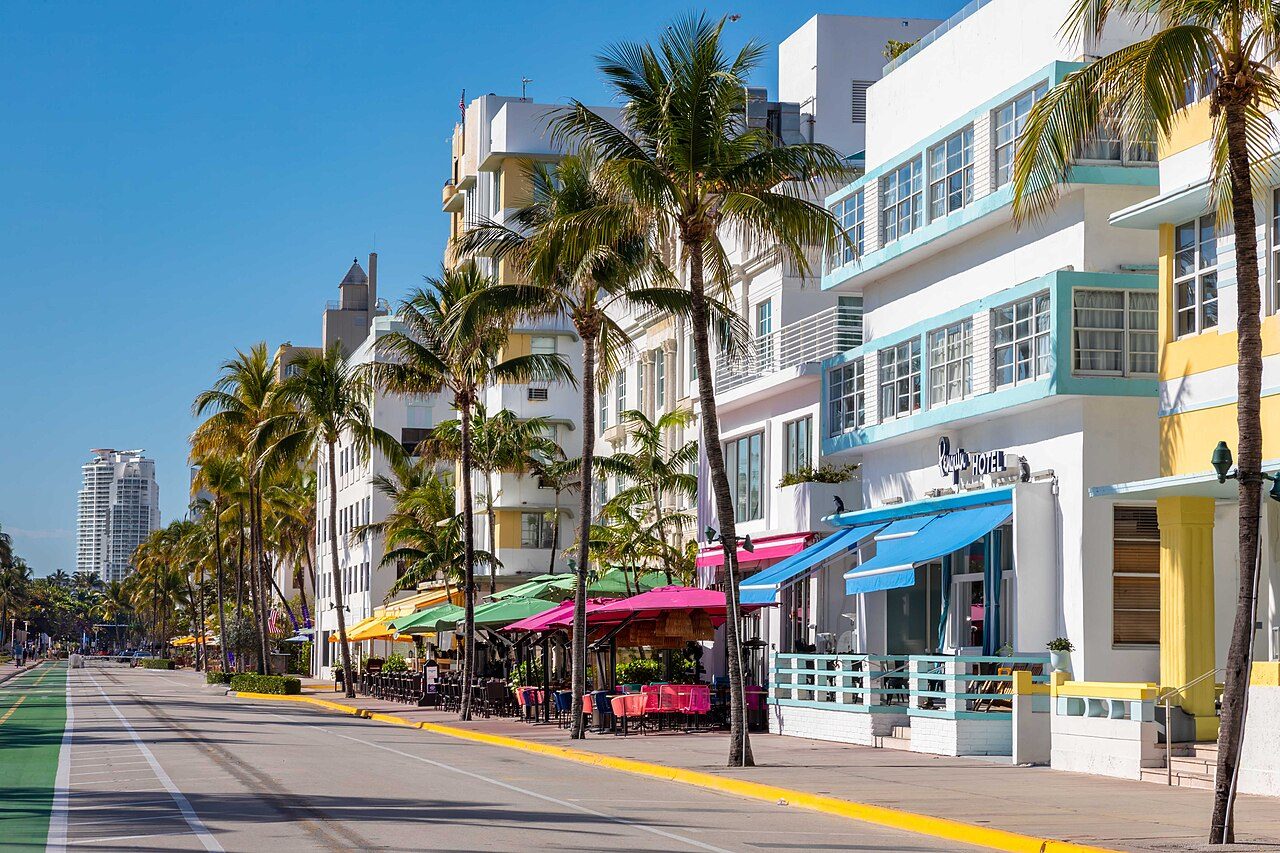
South Beach, roughly 5th to 23rd Street, is the Art Deco district and the postcard. About 800 protected buildings in a square mile, listed on the National Register since 1979. Ocean Drive is the strip everybody photographs and the least rewarding street in it: the same architecture runs along Collins and Washington one and two blocks inland with none of the menu touts. Go at dusk when the neon comes on.
Mid Beach and North Beach, above 23rd Street, are quieter, more residential, and where the beach stops being a scene and starts being a beach.
Little Havana is Calle Ocho, mainly between 12th and 17th Avenue. Domino Park, cigar rollers, ventanitas serving cafecito. It is a working Cuban neighborhood on a weekday morning, a street party on the last Friday of the month for Viernes Culturales, and a coach queue on a cruise ship afternoon. Pick your timing deliberately.
Wynwood is murals, breweries and bars, and it is where Miami nightlife is enjoyable rather than exclusive. The Wynwood Walls complex is ticketed; the surrounding twenty blocks of commissioned murals are free and several are better. Walk NW 2nd Avenue before you decide.
The Design District is luxury retail with serious public art placed among it. An excellent hour, an expensive afternoon.
Little Haiti is the least touristed of the cultural neighborhoods and the one with the most left to find: Caribbean food, music venues, and the Little Haiti Cultural Complex.
Brickell is towers, restaurants and the financial district. Unromantic and the most practical place to sleep.
Coconut Grove is leafy, low rise and where Vizcaya is. Coral Gables is Mediterranean revival architecture, the Biltmore and the Venetian Pool.
THE THINGS WORTH PLANNING AROUND
Vizcaya Museum and Gardens, Coconut Grove: a 1916 Italianate villa on the bay with formal gardens. Book ahead and go early, because the light and the crowds both get worse.
Perez Art Museum Miami, on the downtown bayfront: the Herzog and de Meuron building with its hanging gardens is as much the point as the collection, and the terrace is one of the best free-feeling views in the city.
The Art Deco district: walkable in an afternoon, better at dusk.
Everglades National Park: a day trip from the city, and the reason to keep one day flexible. The eastern entrance near Homestead is about an hour from downtown.
Key Biscayne: Crandon Park and Bill Baggs at the southern tip, with the lighthouse. The calmest beach day within the county.
SPORT AND EVENTS
Hard Rock Stadium in Miami Gardens hosted seven FIFA World Cup matches in summer 2026, including the quarterfinal on 11 July and the third place match on 18 July. It hosts the Miami Open every March, when the complex is rebuilt into a tennis venue, and the Formula 1 Miami Grand Prix every May on the circuit around it. Inter Miami opened Miami Freedom Park, 25,000 seats beside the airport, on 4 April 2026. The Miami Heat play downtown at the Kaseya Center, which is the only one of these reachable on the free Metromover. The Dolphins play at Hard Rock from September.
If your trip overlaps the Miami Open, the Grand Prix or an Inter Miami home match, hotel prices across the whole county move, not just near the venue. Check the calendar before you book, in both directions: to catch an event, or to avoid paying for one you are not attending.
GETTING AROUND WITHOUT WASTING MONEY
The Metromover is free, automated, runs every 90 seconds at peak, and loops downtown, Brickell and the Arsht Center. It is the single best argument for a mainland base and most visitors never hear of it.
Free trolleys run local loops in Miami Beach, Wynwood, Coral Gables and several other neighborhoods. They are slow and they are free.
Brightline runs from MiamiCentral downtown to Fort Lauderdale, West Palm Beach and Orlando. It turns the rest of South Florida into a day trip without a car.
Metrorail connects the airport to downtown and south toward Dadeland. The airport station is on the same complex as the rental car center.
What none of this covers well: the airport to South Beach leg, and crossing a causeway late at night. Budget for rideshares on those two and you will not need a car at all.
If you do drive, understand the parking economics before you book: Miami Beach hotels charge nightly for parking on top of the room rate, and street parking on the island is metered, app based and enforced.
WHEN TO GO
December to April is the dry season: warm, low humidity, and the highest prices of the year, especially around the holidays, Art Basel in early December and the March spring break weekends.
May to November is hurricane season, with the genuine risk concentrated in August, September and October. Those months are also humid enough to change what you can comfortably do outdoors between roughly 11am and 4pm.
Late April, May and November are the value window. Warm water, thinner crowds, prices well below peak, and weather that still works.
SPRING BREAK, SPECIFICALLY
Miami Beach spent recent years trying to shut spring break down and changed course for 2026: the blanket curfew was lifted, the beaches no longer close at 6pm, and the city is courting families again. The restrictions that remain are the ones that catch ordinary visitors rather than partygoers. No alcohol on the sand at any time of year. No coolers, glass, tents, inflatables or amplified music without a permit. On peak March weekends: security checkpoints at beach entrances, restricted vehicle entry to the island, and a single forced exit at 5th Street. Police presence stays heavy regardless.
COSTS, HONESTLY
The beach is free and swimmable year round, which is the best value in the city. Hotel bills are where Miami takes it back: Florida state sales tax, a county tourist development tax, and in Miami Beach an additional city resort tax, all stacked. Mandatory resort fees are treated as part of the taxable room charge in Florida, so a resort fee is taxed at the same rate as the room rather than sitting outside it. Read the total, not the nightly rate.
Food is where you decide the trip's budget. A counter Cubano and a cortadito costs less than a coffee on Ocean Drive. Eating inland is not a sacrifice here; it is the better meal.
Places this guide mentions
Been there? Correct us.
Prices move, routes close, places go downhill. A first-hand review is worth more than this guide and will be shown alongside it.
Share your experienceComments
No comments yet.